
2026
The Journey Ahead
“The real voyage of discovery consists not in seeking new landscapes, but in having new eyes”
- Marcel Proust
The plan, as we have envisioned to date…
1. Expedition
On July 29, 2026—exactly 250 years to the day after the original expedition—we depart from Santa Fe Plaza at noon, heading north into the unknown just as the friars did in 1776, just as my father did in 1976.
The Route
1,900 miles through New Mexico, Colorado, Utah, and Arizona
Four months on horseback (July 29 - November 28, 2026)
Following the meticulously documented 1976 maps my father left behind and adjusting as needed.
The Team We're Recruiting
A 6-8 rider “core team” committed to the full journey including (we hope): veterinarian, farrier, doctor, a cook. These folks ought to be, unlike myself presently, comfortable with long days in the saddle.
Paid participants (they all paid to play in 1976, too!) whose fees will also help subsidize seats for those who couldn't otherwise afford to join.
Guest riders joining for segments, including (we hope) Indigenous and Hispanic community representatives.
Support vehicle(s) and trailer with veterinary care, supplies, and safety equipment
On the off chance we end up with the funding we hope for…
Additional support crew including veterinarians, camp managers, logistics coordinators, and a good cook.
2. Documentary
The idea to make a film came from Sarah Olivier, Executive Director at Colorado Humanities—who has been an incredible source of inspiration. The more I've discussed it, the more excited I've become about documenting this journey on film.
The team needs a filmmaker/cinematographer and sound person—preferably with riding experience, though not necessarily for the entire ride. Or it might just be me with a camera and a couple mics… fair warning!
My vision weaves three temporal threads through contested and sacred landscapes. The 1776 journals reveal wonder and desperation; my father's 1976 archive captures post-Vietnam America grappling with identity during bicentennial celebrations; our 2026 footage documents the raw reality of inheriting complicated legacies in contemporary America.
I also aim to document my own physical, mental, emotional, and spiritual journey: building a team, seeking funding and sponsors, completing the expedition.
As miles accumulate, you'll witness genuine change—not a manufactured redemption arc but earned understanding of what it means to carry ancestral stories you've never learned to tell.
The Climactic Choice
On 10/9/26 we'll face the same decision as our predecessors: follow the documented route east back to Santa Fe, honoring what happened? Or turn west through Nevada to California, attempting what neither my father nor the original friars accomplished—reaching the Spanish missions that were always the intended destination?
3. Education
My two children are in elementary school now; my oldest, recently enthusiastic about the Domínguez-Escalante story, set out to see if his school library contained anything about their journey. Shockingly… nothing.
Of course, this was not a surprise. This is, at best, forgotten history; at worst, neglected history. Our vision is to share this story. This includes school aged kids across the country.
Fortuitous Partnerships
In late October, DESERT26 into a partnership with the Domínguez-Escalante Expedition Education Project (DEEEP)—an organization to which I am forever indebted for graciously helping me jump start this whole effort—to leverage the K-12 curriculum on D-E which they have already created.
Additionally, Paula Withrow (née Veaudry), who helped my father, Gordon, and Joe plan/organize the 1976 expedition, has been brought the D-E story to Appalachia via a series of courses taught at Blue Ridge Community College in North Carolina in 2011 and 2015. She is currently working on a D-E course for college seniors. She, too, has graciously offered to share her materials with DESERT26.
Our goal is to get these materials into as many classrooms across the country as we can, leveraging the visibility of our expedition to highlight the importance of celebrating the history created in the Southwest in 1776—by our other founding fathers, Domínguez and Escalante—alongside Washington, Jefferson, Adams, Monroe, etc.
Riding lessons started 11/7/25…
Stay Tuned!
4. Community
“One of the main goals of the DEBE was to reawaken the Southwest to the riches of its cultural heritage”.
That goal was accomplished on a scale that the organizers never thought possible. Each event had a size and nature unto itself.
For instance, the mass which was celebrated at the Salt Palace in SLC, UT on 9/26/76, required a great deal of advance planning. Ultimately, 13,000 people from across the west came to witness the service.
On the other hand, the sack lunch which expeditioners enjoyed in Nephi, Utah two days later was a purely spontaneous civic gesture and handled solely by the community’s mayor and assistant.
No matter the event’s size or scope, however, the post is that due largely to the coming of the DEBE, citizens across the Four Corners states took an active role in the celebration not only of their heritage, but also of the nation’s bicentennial observance.
Consequently, one is led to believe that in the future, the D-E trail could be uses as a vehicle for promoting continued cooperation among the trail area’s predominant Anglo, Native American, and Hispanic cultures.”
Our plan: follow the 1976 plan, which was no plan—at least for centralized organization—of community events. We will work with any and all communities along/near the route that want to create events that reflect the local spirit and interests in the legacy of D-E, Colorado’s 150th and America’s 250th.
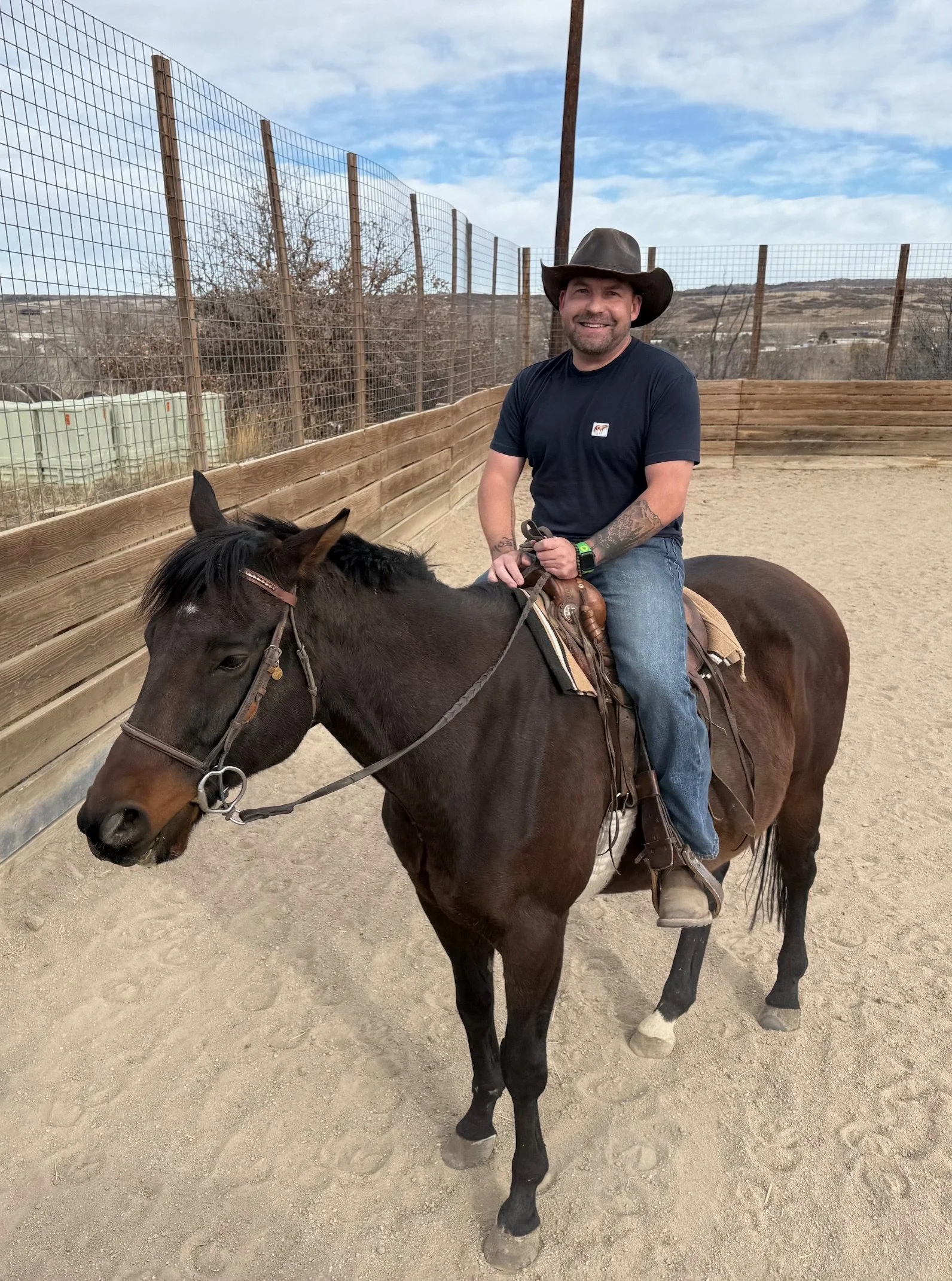
Riding lessons started 11/7!
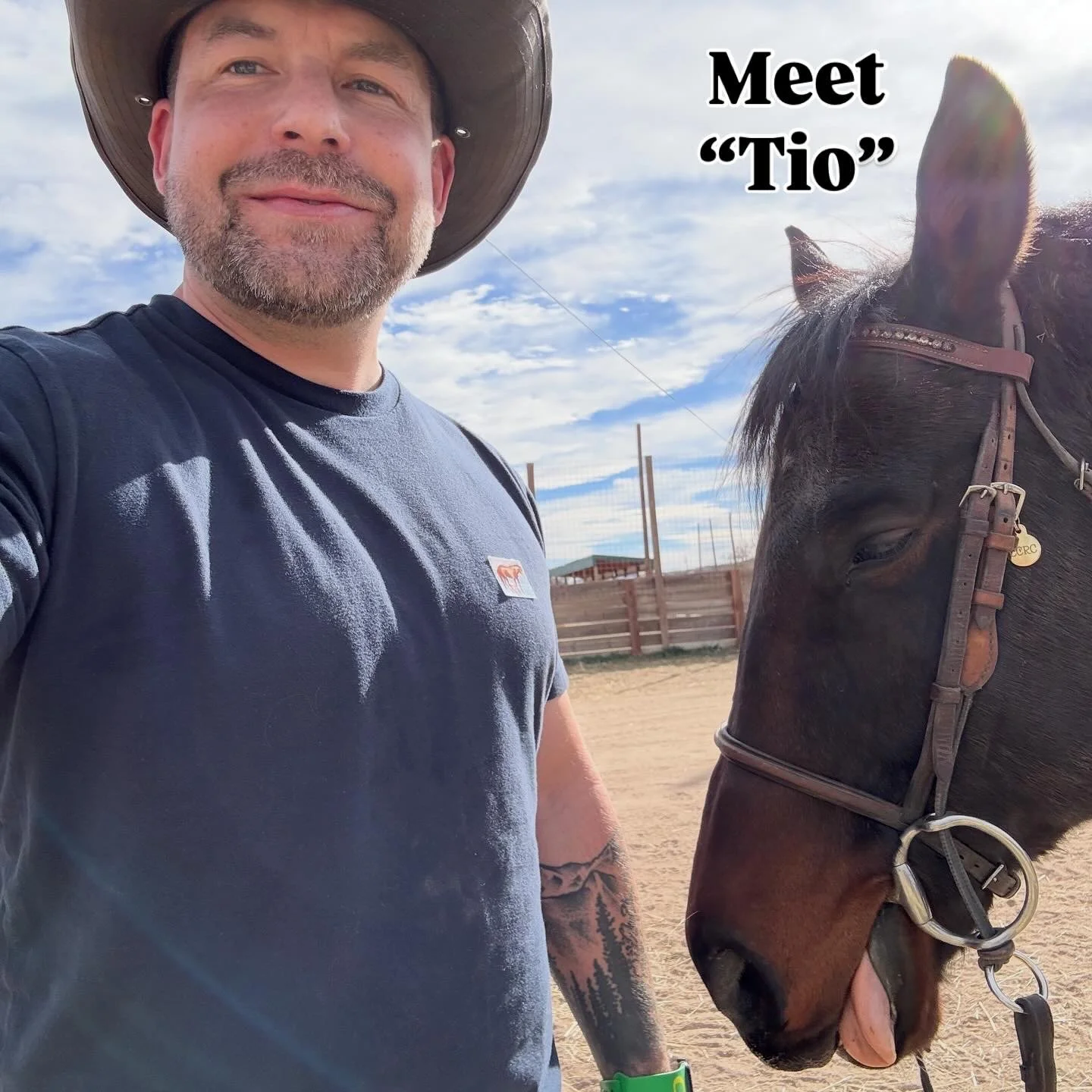
Meet "Tio" a thoroughbred and former racer; my current training companion.
The Wrong Person for the Right Job
Hey, this is Ryan and I am spectacularly unqualified for this!
My horseback riding experience over the past decade amounts to maybe four hours across a few trail rides that left me sore for days. I can manage to mount a horse—usually—but navigate 1,900 miles of desert canyons and mountain passes… on a horse!? The learning curve will be steep, public, and occasionally humiliating.
I found it oddly difficult to find a riding teacher … Of the dozen or so facilities I reached out to, only 3 returned my messages!
I'm a sixth-generation Coloradan who needed Wikipedia to understand what an acequia is, despite my family having survived in the desert for generations because of them. My Spanish is embarrassing despite a grandmother who spoke it fluently. I know more about electric vehicle charging infrastructure than my mestizo roots. Juan Cristobal Tafoya, my great-great-great-grandfather, was elected sheriff of Trinidad, Colorado in 1870, he was killed defending his community in 1871, yet I couldn't navigate those ancestral homelands without GPS.
Recently laid off for the third time in six years from a largely thankless 15-year career in sustainable transportation, the universe is clearly trying to tell me something … that my future lies elsewhere.
Now I'm attempting to lead a horseback expedition I have no business leading.
But here's the thing: this isn't about being the most qualified person—it's about being the person who can't walk away.
My Colorado Family Tree
An American Mutt in every way
Growing up, my Hispanic/Spanish/Mexican/Native heritage was a source of constant fascination for me—and the fuel for endless shade thrown by cruel teenage friends. Assholes. Ha!
My “DNA Origins” from Ancestry.com
Truth told, however, I still do not know much about the Tafoya ancestors who first appeared in Colorado in 1859. Their ancestors and the other ancestral lines of my late 18th and early 19th century ancestors—Padilla, Gutíerrez, Cortez, Martinez, Bernal, Martin, Serrano—had been in New Mexico since…
We don’t really know! But, this much I do for certain: they were in New Mexico, some of them in Santa Fe, when Fathers Domínguez and Escalante set out for California.
Almost nothing is known about my Native ancestors. My grandmother believed they were Navajo but they could have just as easily been Hopi, Ute, Paiute, Apache… who knows! What I do know is that it is there, in me.
So, for me, this expedition, this story, is so much more that just an attempt to accomplish something big. It is quite literally a chance to go home, to better understand from where I come so that I may know better where I am headed. This is part of my American story!
Of course, I would be remise if I did not also at least mention and acknowledge similarly incredible journeys of my other immigrant ancestors. Most relevant, at least to 1776, is the Benscoter family on my mothers side.
Her ancestors, having homesteaded on land we still own in northern Idaho, came from Germany, England, Ireland, and the Netherlands. Theunis Eliasen Van Bunschoten first appears in the “New World” in 1671 in Kingston, NY. His family had come through New Amsterdam (err, New York City) two centuries before Ellis Island; they were from Bunschoten, Netherlands.
His great-great grandson, Jacobus “James” Van Bunschoten, was a inn-keeper in Walpack, on the New Jersey side of the Delaware River, along the border with Pennsylvania, as late as 1788. And by 1796… Westward!
Pennsylvania for nearly one hundred years before the fertile farmlands of the Clearwater River valley of Idaho in the early 1890’s.
The source of this information is, in and of itself, a marvel of early 20th century genealogy research! Concerning the Van Bunschoten or Van Benschoten Family in America: A Genealogy and Brief History. Originally published in 1907, this brief narrative tallies 813 pages… before the index! The full text of this saga is available at archive.org (in case you feel compelled to fact check my work!!
Suffice it to say: my ancestors blood—whether Native or European—has been part of this country’s story far longer than most!
Perhaps the next adventure tackles the story of these hearty Americans…
“…Daley, whose mother is of Mexican-Indian descent…”
…reads a portion of the article written about the DEBE in the Southern Utah News (Kanab, UT) on October 7, 1976.
My grandmother, Ermiña Marie Padilla Daley, would have abhorred this inglorious description of our heritage. I recall her insisting during my childhood that we are not Mexican… “we’re Spanish” she would instruct sternly!
Grandma “Marie” was born January, 14, 1914 at Ludlow, Colorado. Yes, that Ludlow!
As it turns out, though, her father, Elfego Padilla, was in fact born in San Juan, Jalisco, Mexico in April 1880. Perhaps her disassociation with his place of birth stems from the fact that he abandoned my great-grandmother, Clorinda Tafoya, and her five children—including my grandmother at the age of 3 months—during the Ludlow Massacre on April 20, 1914.
Until the early 2000’s, family lore told that Elfego died in the miners’ fight against the Rockefeller-organized militia. Yet, he appears again in a 1920 census… in Koehler, New Mexico!
The result: Grandma Marie grew up in an orphanage in Pueblo, Colorado. Emancipated at 18, she was a domestic servant in La Veta, Colorado for a time before finding her way to Denver and my grandfather, Alfred Daley of New Jersey.
Grandma Marie, the toughest person I’ve ever known, died March 19, 2019, at the age of 105.
My American Family Tree
Sheriff Jaun C. Tafoya
Las Animas County
On February 6, 1872, three brothers with the last name of Wilson rode into Trinidad from Texas. During their stay in town one of the brothers ended up at the Exchange Saloon for some gambling and drinking. Thinking he had been cheated, he roared out of the saloon yelling that he would be back. While the Wilson brother was gone the barkeep sent for the Sheriff.
Sheriff Tafoya was waiting quietly when the cowboys returned with their guns drawn. Despite the saloon's offer to return the money, Wilson declared that someone was going to die. As Sheriff Tafoya moved forward to grab Wilson's gun, Wilson fired twice, hitting Tafoya in the chest and the head. The Wilson's barreled out of town, but a posse was quickly formed. The posse gunned down two of the Wilson brothers in a running gunfight to the east of Trinidad near present day Beshoar Junction. Believing he would be spared, the other Wilson brother surrendered to the posse. After listening to his plea for mercy, the posse hanged the last Wilson brother from a cottonwood tree on Gray Creek Trail (now Gray Creek Road), as a warning to other would be scoundrels.
Sheriff Tafoya served as a deputy to Sheriff Juan Gutierrez during the Christmas Day War of 1867. He was elected Sheriff in 1870, left office later that year and was appointed Sheriff after the removal of the elected Sheriff in 1871 then reelected prior to his death.
Source: Colorado State Patrol
“That James was in the Revolution is not a matter of record. He lived, though, on the very frontier, daily knew danger there, and must have had vivid knowledge among other things of Brant’s raids on the Minisink settlements though living to the southward. Circumstances will not permit us to doubt that he served at least in some local corps of emergency men, if not indeed in some more pretentious New Jersey organization; but nothing authentic has survived,—neither muster-rolls, pension nor other evidence,—to put the matter beyond question. A tradition exists in the family that he took part in the war: ‘I have been told from my youth,’ wrote William Ide (Van) Benscoter, ‘that great-grandfather James was a Minute Man in the Revolution, and that my grandfather when eight years of age tried to follow his father off to the war.’ His brother Cornelius is found enrolled in New Jersey.”
My Inheritance
My father, William “Bill” Daley, died on August 14, 2025. He fell, his heart stopped. In the end, he had given up and his demons had won. He left me with a profound contradiction: on one hand, an extraordinary archive from his 1976 expedition leadership—official reports, personal journals, hundreds of marked topographic maps, newspaper editorials, dozens of original photographs. A treasure trove documenting something remarkable, historically significant, beautifully executed.
On the other hand, the last 5-years or so of his life and the manner of his death—complicated, messy, angry, forgettable—threatened to overshadow everything else: a decorated military career followed by a nearly three decades of public service in wildlife and natural resources conservation. Nearly all of my memories as a child are positive—an engaged and caring father, a proud grandfather who thankfully, and despite his condition, spent a couple of very meaningful years helping raise his grandchildren. All that good work, that meaningful contribution to American historical understanding, reduced in family conversations to the circumstances of his final years - disinterested and disengaged, lacking purpose and hope. That is not the legacy he would have wanted us to carry forward. It’s not the legacy he deserved.
Therein lies the contradiction within the inheritances many of us receive—not clean narratives of heroism or failure, but messy human stories of people who accomplished meaningful things while battling personal demons. The question becomes: which part of the legacy do we carry forward?
“God, grant me the serenity to accept the things I cannot change, the courage to change the things that I can, and the wisdom to know the difference”
Why This Story Matters to Me
As someone in long-term recovery from addiction, I understand that healing—personal and historical—requires acknowledging hard truths and making amends.
There were dozens of moments that should have been rock bottom but weren’t. There are even more mistakes which I regret deeply. Ultimately, over a two-year period from 2019-2021, I would lose my company, my marriage, and nearly my children. It’s hard to remember how close I actually was to my own death before I decided to ask for help, and despite the countless offers for help from friends, loved ones, and strangers.
Recovery teaches that we build something better for ourselves and those who come after us through discipline, patience, and rigorous honesty. In recovery, we develop an ability to embrace uncertainty and surrender the outcome
of whatever comes our way only with a thorough grasp on, and acceptance of, how very little we are actually in control of.
The same principles that saved my life now guide my approach to this expedition and fatherhood: honesty about our failures, humility in seeking help, and service to something greater than ourselves.
My ten-year-old son will, I hope, choose to ride with me for portions of this journey. Not because I'm trying to be Father of the Year, but because I want him to understand what it means to carry forward complicated legacies, to honor imperfect people who did meaningful things, and to learn that sometimes the most important journeys are undertaken not by experts, but by those called to complete something larger than themselves.
The Stakes
This may be a last chance to retrace this route in anything close to its original form. Climate change is altering the West. Development is closing access. The people who knew the 1976 trail firsthand—my father's team—are passing.
We have one shot at this. Miss it, and the anniversary that makes it all meaningful disappears for another 50 years. The 1976 expedition was meticulously documented but never shared beyond the Four Corners states—a mistake we cannot repeat.
This isn't about being qualified. It's about being called. Sometimes the most important stories are told not by the most capable voices, but by those who can't bear to let them go untold.