
1776
In Behalf of the Light
Their task was simple albeit difficult: connect Santa Fe to Monterey and in doing so link Spanish New Mexico to Alta California. A few years earlier, a string of Spanish settlements had begun to take shape along the Pacific coast and officials welcomed the prospect of connecting the empire’s vast holdings in the north to stem the threat of Russian and British expansionism. The Franciscan leadership meanwhile welcomed the prospect of expanding missionary activity among new peoples. At the same time, the collapse of an alliance with the Comanche led the Ute to contemplate a new relationship with the Spanish. Into this flux, entered two adventurous friars, Francisco Atanasio Domínguez and Silvestre Vélez de Escalante.
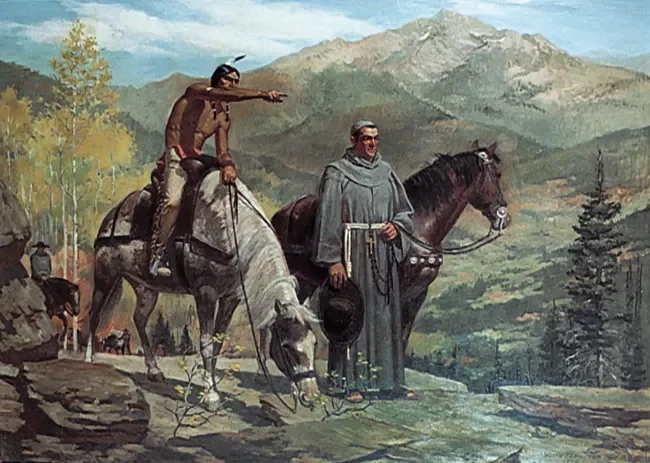
Father Escalante Discovers Utah Valley by E. Keith Eddington. Source: National Park Service
Source: Crow Canyon Archaeological Center
2014 Peoples of the Mesa Verde Region [HTML Title].
Available: https://www.crowcanyon.org/peoplesmesaverde
“They trailed north out of Santa Fe on July 29 with no idea of what lay ahead. Historian Herbert Eugene Bolton exalted their trek as a ‘pageant in the wilderness.’ Hardly more notable than ticks on an elk’s belly, these motley dozen souls were poised, nevertheless, to make one of the truly epic explorations of the American West.”
In the 1760s, Spanish exploration extended deep into present-day Colorado. At least two expeditions led by Juan María Rivera reached as far as the Gunnison River, establishing curiosity among New Mexicans concerning what lay further in the distance and new trade ties with the Ute. In this period, New Mexicans harbored fantastical visions of the north - a mythical land they called Teguayó. The Rivera expeditions began to alter this view, but the region remained mired in mystery.
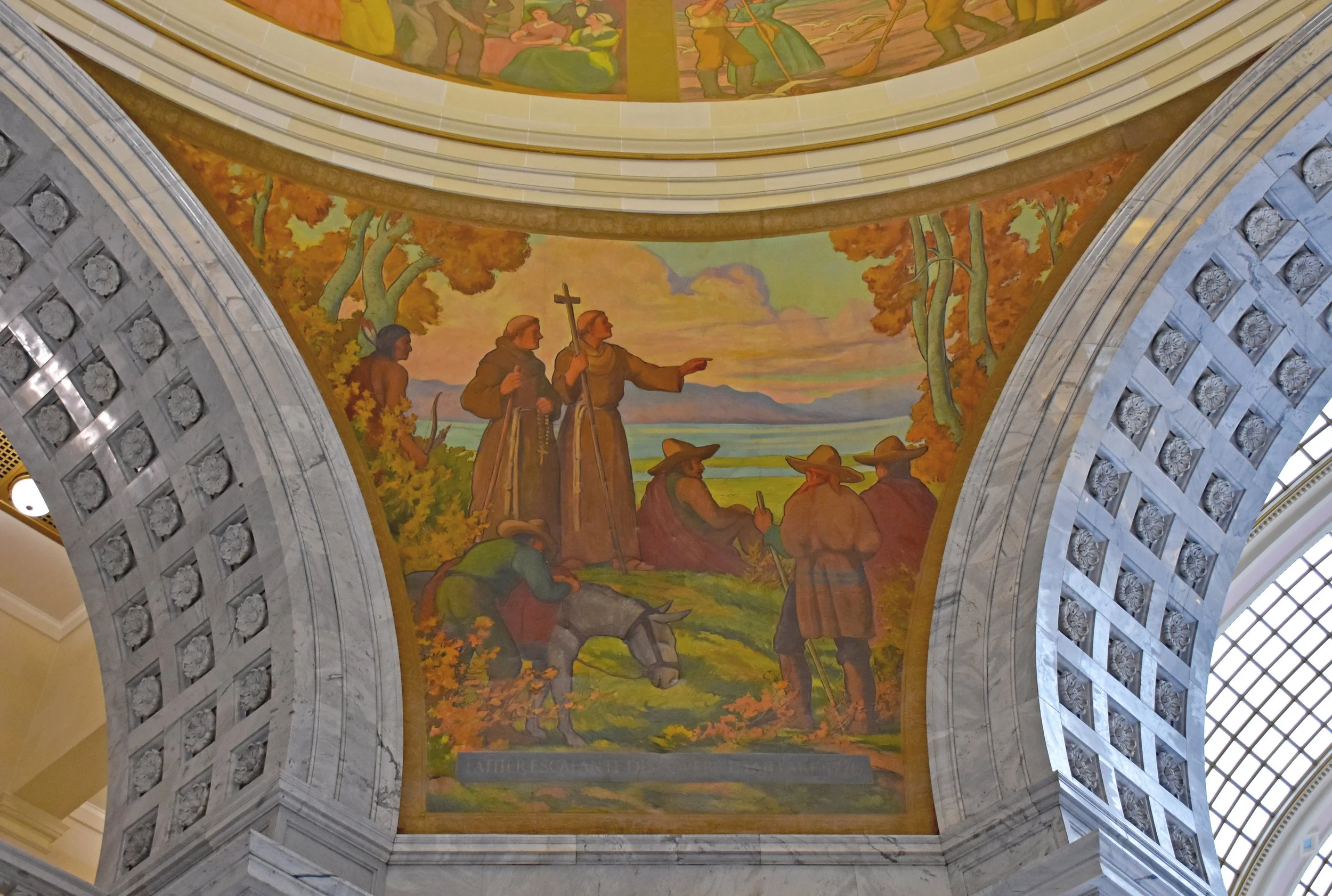
'Father Escalante Discovers Utah Lake, 1776,' as painted on one of the pendentives in the rotunda at the Utah State Capitol. Painted by Lee Greene Richards (with assistance from Gordon Cope, Waldo Midgley, and Henry Rasmussen). Original painting commissioned and funded as part of a Public Works of Art Project (PWAP) during the 1930s.
Domínguez and Vélez de Escalante recruited a multicultural mix of eight men to accompany them, drawing from the members of the Rivera expeditions and finding a cartographer named Bernardo de Miera y Pacheco. Originally set to depart on July 4, 1776, their trip was delayed by a Comanche raid on New Mexico. Setting out twenty-five days later, they ventured into a foreign land that featured wide rivers and mountains much higher than anywhere in New Mexico. Along the way, they were joined by two runaways from Abiquiú and several Ute guides who directed them across river fords, through deep canyons, and over mountain passes to reach the Utah Valley and return to Santa Fe in early January 1777. Although they fell short of Monterey, all of the men returned home. In the course of their journey, the travelers made contact with several tribes that had not previously encountered the Spanish and mapped extensive portions of western North America.
“The expedition would alter the lives of many of the tribes living in the region, for Fray Francisco Atanasio Domínguez and Silvestre Vélez de Escalante were harbingers of change.”
In total, they crossed 1,700 miles through inhospitable and rugged terrain. Among their various accomplishments, they survived travel through Comanche territory in the face of repeated Ute warnings. They survived injury and disease while foraging from the land and trade with Native hosts. In order to make their return to New Mexico, the men crossed the Colorado River within Glen Canyon, hacking steps out of sandstone to take their horses to the water. Vélez de Escalante’s journal provided significant geographic and ethnographic information regarding the lands and peoples they encountered along the way while the maps produced by Miera y Pacheco contributed to the exploits of later expeditions in the next century.
This 1776 narrative was authored by Charles Nicholas “Nick” Saenz, Asst. VP of Academic Affairs and Professor of History at Adams State University in Alamosa, Colorado.
The title of this article, “In Behalf of the Light”, is the same as was used in a publication produced by the 1976 Domínguez-Escalante Bicentennial Expedition In Behalf of the Light: The Domínguez-Escalante Expedition of 1776 by Joseph Cerquone.
Your History Books also Forgot to Mention…
Sources
Chávez, Thomas E. Spain and the Independence of the United States: An Intrinsic Gift. Albuquerque: University of New Mexico Press, 2002.
Chávez, Thomas E. "Benjamin Franklin, Spain, and the Independence of the United States." In Spanish Influence on American History, Gilder Lehrman Institute of American History.
"Spain and the American Revolutionary War." TeachingHistory.org, National History Education Clearinghouse.
"Revolutionary War Service Expanded to Include Spanish Military on the Island of Cuba." Daughters of the American Revolution, 2025.
Additional/Related Work by Dr. Chávez
Chávez, Thomas E. The Diplomacy of Independence: Benjamin Franklin Documents in the Archives of Spain. Philadelphia: University of Pennsylvania Press, 2024.
Chávez, Thomas E. Revolutionary Diplomacy: Spanish Connections and the Birth of the United States. Charlottesville: University of Virginia Press, 2025.
Spain: The Forgotten Ally of American Independence
Based on the Research of Dr. Thomas E. Chávez
While American history textbooks celebrate France's assistance during the Revolutionary War, they largely omit Spain's critical contributions to American independence. Dr. Thomas E. Chávez, former director of the National Hispanic Cultural Center in Albuquerque and the Palace of the Governors Museum in Santa Fe and research associate at the University of New Mexico, has spent decades correcting this historical oversight through his groundbreaking research in Spanish archives.
In his seminal work, Spain and the Independence of the United States: An Intrinsic Gift (2002), Chávez reveals that Spain's support was decisive in securing American independence. Beginning in 1776, Spain secretly funneled massive financial support to the Continental Army—initially contributing one million French livres alongside France. This money was laundered through a fictitious trading company, Roderigue Hortalez and Company, operating from the Lesser Antilles. These funds enabled the Americans to stabilize their new currency, the Continental, and recruit foreign military officers including Augustus von Steuben, Casimir Pulaski, and Thaddeus Kosciuszko.
Spain's material support was equally substantial. The initial joint Spanish-French shipment alone provided the Continental Army with 216 cannons, 27 mortars, 12,826 grenades, 300,000 pounds of gunpowder, 30,000 muskets with bayonets, 4,000 tents, and 30,000 complete uniforms. With these Spanish provisions, General Horatio Gates achieved his crucial victory over General John Burgoyne at Saratoga in October 1777—the turning point that brought France openly into the war.
After entering the conflict formally in 1779, Spanish military forces under Governor Bernardo de Gálvez captured key British positions along the Mississippi River from New Orleans to St. Louis and as far north as Michigan, securing Mobile and Pensacola along the Gulf Coast. These campaigns prevented any British offensive through the western frontier and secured the southern supply routes vital to the Continental Army. Spanish forces also attacked British positions in Central America and the Caribbean while maintaining a costly siege of Gibraltar—all of which diverted British military resources that would otherwise have been deployed against the American rebels.
Perhaps most significantly, Spain provided the gold and silver collected in Havana—and partially sourced by taxing the entirety of Spanish colonies in the Americas, including the New Mexicans Domínguez and Escalante lived among—that financed the final siege of Yorktown in 1781—and enabled the decisive victory that ended the war.
In recognition of these contributions, George Washington honored the Count of Gálvez by taking him to his right in the July 4th victory parade, and the Continental Congress officially cited Gálvez for his aid during the Revolution. Yet as Chávez documents, this history was deliberately forgotten—what he calls America's "self-induced amnesia"—stemming from guilt over later seizing Spanish territories including Florida and the Louisiana Territory—from the very nation that had helped secure American independence.
Chávez's research, based on primary documents from Spanish archives, demonstrates that without Spain's financial backing, military supplies, strategic military campaigns, and the diversion of British forces across multiple fronts, the American Revolution would likely have failed. As Chávez argues, America quite literally "owes its independence to liberal applications of Spanish silver and the lives of Spanish subjects."